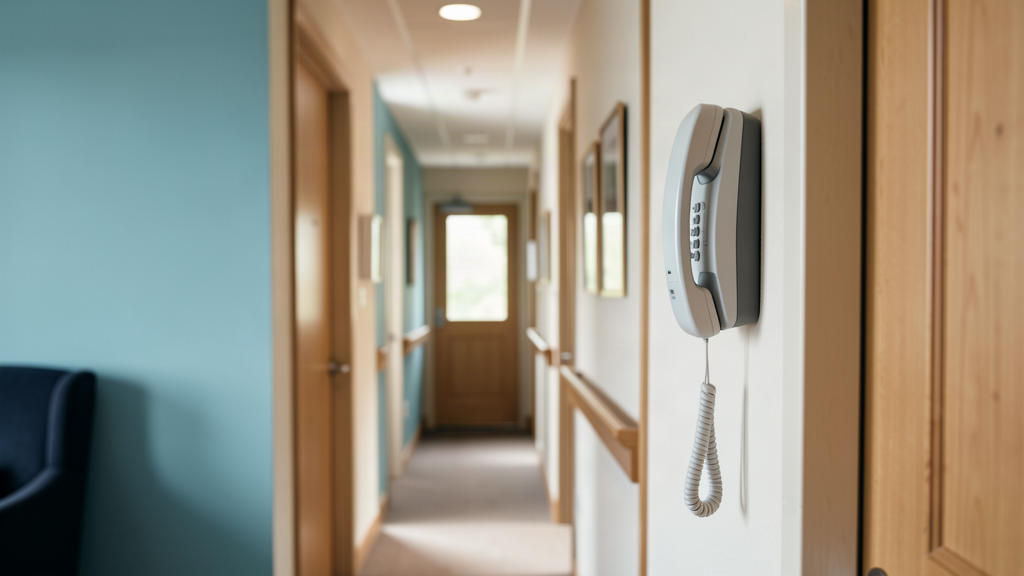
Nurse call system requirements come from three separate places: the life-safety and health care codes a facility is surveyed against, the product standard its equipment is listed to, and the licensing rules the operator answers to. For hospitals and long-term care facilities that take Medicare or Medicaid, CMS names the first two outright — NFPA 101, the Life Safety Code, and NFPA 99, the Health Care Facilities Code, with chapters 7, 8, 12 and 13 of NFPA 99 carved out. What that means in practice is narrower than it sounds: a system that signals, a path to the people who respond, and evidence that both still work.
Which Codes Apply to a Nurse Call System
Start with the occupancy, because the requirement follows the building, not the equipment brochure. A hospital must meet the applicable provisions of the Life Safety Code and, separately, must proceed in accordance with the Health Care Facilities Code — chapters 7, 8, 12 and 13 of NFPA 99 do not apply — under 42 CFR § 482.41. A long-term care facility is held to the same two codes, with the same four chapters carved out, under 42 CFR § 483.90. Both sections let CMS waive specific provisions on a hardship finding, which is why the waiver letter in your file can matter as much as the code text when a surveyor asks how a condition was met.
Those two sections are the floor for a certified building. State licensing rules and the local fire code are enforced by different people than a CMS survey, and they are checked separately. Review them for your own sites rather than assuming the federal codes cover everything a licensing inspector will ask about.
What the Codes Require of the System Itself
Two sentences in the long-term care rule carry most of the weight for a device like this. The first requires the facility to "maintain all mechanical, electrical, and patient care equipment in safe operating condition" (42 CFR § 483.90(d)(2)). The second governs emergency power: an emergency electrical system must supply power at least for lighting all entrances and exits, for "equipment to maintain the fire detection, alarm, and extinguishing systems," and for life support systems when the normal electrical supply is interrupted (42 CFR § 483.90(c)(1)).
Read together, they draw the line that matters for a nurse call system. The regulation treats the system as patient care equipment that has to be maintained in safe operating condition, and the emergency-power sentence draws its line at fire detection, alarm and extinguishing equipment plus life support systems. Whether a particular nurse call path must ride the generator is a question for your engineer, your authority having jurisdiction and your licensing surveyor — not a default to assume in either direction. What is not open to interpretation is the maintenance record.
The Equipment Standard: What ANSI/UL 1069 Covers
The product side has its own standard. ANSI/UL 1069, Hospital Signaling and Nurse Call Equipment, is the UL standard written for this category; UL's current edition is dated February 8, 2024 and is ANSI-approved (UL 1069). It addresses the equipment, not your facility's compliance program.
That separation is where nurse call migrations get messy. Swapping a controller for a currently listed unit while keeping decades-old call stations, pull cords and annunciators leaves a mixed installation, and mixed installations are what make the documentation painful later. Before accepting a quote that changes one box, ask which components carry a current listing and which ones are being left in place.
When the Nurse Call Path Runs on a Copper Phone Line
If your nurse call design uses an analog line for one specific job — reaching an off-site monitoring center, a pager gateway, or a dialer that summons help when the desk is empty — then that line is the part of the system nobody at the facility controls. The nurse call hardware can be in perfect order and the signal still stops at the demarcation point.
The FCC's network-change rules define a copper retirement as the removal or disabling of copper loops, subloops, or the feeder portion of such loops or subloops, or their replacement with fiber-to-the-home or fiber-to-the-curb loops, and require the incumbent carrier to give public notice of any network change that will result in one (47 CFR § 51.325). For a facility with a nurse call path on copper, that carrier notice is the first hard date on the project calendar.
Testing and Documentation: What a Surveyor Will Ask For
A nurse call system is judged on evidence as much as on function. The file a surveyor can work with looks like this:
- A test schedule with dates, the station tested, who received the signal, and how long the response took.
- A record of what each test covered — call station, annunciator, pager, and the off-site path if there is one.
- The equipment maintenance record, tied back to the safe-operating-condition requirement.
- A line inventory showing which nurse call components connect to which circuit, and whether that circuit is still a live service.
- A named owner for the task, not a department.
A test result you can produce a year later settles a survey question. A system that "works" because nobody has watched it fail is a schedule waiting to slip.
How to Sequence a Nurse Call Migration
There are two orderings to choose between: replace the nurse call system outright, or keep the field devices and change the path they use to signal. Where the second option fits, it lets you retire the copper dependency now and give the capital replacement its own project (the voice paths we design and manage across a portfolio).
Three things need to happen in order regardless of which route you take: inventory every circuit the system touches before anyone cuts one; put in writing which components are replaced and which stay; and test the full path — station to annunciator to off-site — after the cutover, not just the components that changed. It also helps to know how much of your estate still depends on copper before a carrier makes the decision for you (check copper-sunset risk across your sites).
The layers matter when you sign off. Dialing and transport obligations sit with the voice network that carries the call — for our customers, the MIX Networks voice network. Device certifications belong to the equipment manufacturer. Design, configuration, cutover and operation on site is TrustedNetworx's work. None of the three substitutes for the others, and the requirements do not merge into one check (what emergency call requirements look like in senior living, and our guide to senior living telecom compliance for the wider code set).
If you are holding a survey date, a carrier notice, or a capital request, the inventory is where the answer starts. Tell us what your nurse call system looks like today and we will tell you what needs attention before the next inspection.
About the author
Carter Dewey
Carter Dewey is CEO & Founder of TrustedNetworx, helping multi-site organizations navigate telecom modernization, POTS replacement, and AI-powered operations — translating complex infrastructure challenges into practical, phased migration roadmaps.