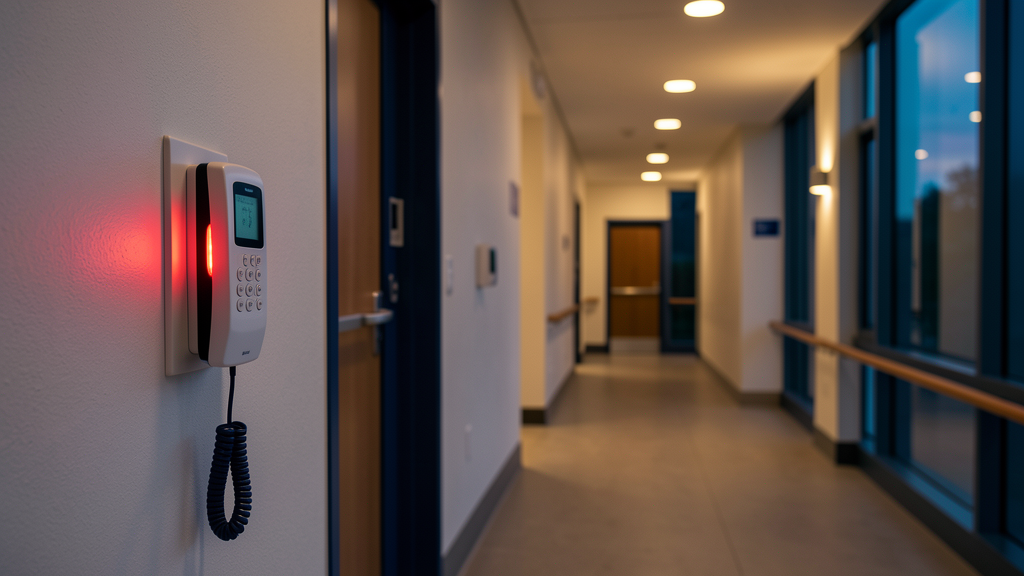
If you operate a senior living facility, your emergency communication systems aren't optional. They're life-safety infrastructure, and regulators treat them accordingly.
But here's what most operators discover too late: the requirements are spread across multiple codes, enforced by different authorities, and tied to phone lines that carriers are actively discontinuing.
Here's what you actually need to know — organized by system, not by code.
Nurse Call and Emergency Call Systems
Every resident-accessible area needs a means to summon help. In independent living, that typically means pull cords in bathrooms and bedrooms. In assisted living and skilled nursing, it means full nurse call systems with annunciation panels at staff stations.
The requirement isn't just that the system exists — it's that it's supervised. If a call station loses connectivity or a pull cord is disconnected, staff need to know immediately. A system that silently fails violates both state regulations and your duty of care.
The copper sunset complicates this. Many legacy nurse call systems connect back to a central controller over analog phone lines. When the carrier disconnects those lines, the system goes dark. Plan your migration to IP-based or wireless nurse call before the disconnect notice arrives.
Fire Alarm System Communications
NFPA 72 governs fire alarm communications, and it doesn't care that your building was compliant in 2010. The standard is continuously updated, and AHJs (authorities having jurisdiction) increasingly require digital monitoring.
Your fire alarm panel must communicate with a central monitoring station over two supervised paths. The traditional setup — two POTS lines — is becoming unsustainable as carriers sunset copper and raise rates on the lines that remain.
The three viable paths today are:
-
Cellular communicators — Dedicated cellular units that connect directly to the fire panel. UL 864 listed, purpose-built for fire alarm use. No dependency on building phone lines.
-
IP communicators — Network-based communicators that use the facility's internet connection with cellular backup. Requires coordination with IT to ensure the fire panel gets priority bandwidth and doesn't go down during network maintenance.
-
Mesh radio — Private radio networks used by some monitoring companies. Reliable but geographically limited.
Whichever path you choose, it must be supervised end-to-end and listed for fire alarm use. Consumer-grade cellular or VoIP won't cut it with an AHJ.
Elevator Emergency Phones
ASME A17.1 requires every elevator to have an emergency phone that auto-dials a 24/7 response center. It must be connected to a dedicated line identified at the monitoring center by elevator and building location. When a resident presses the button, responders need to know exactly which cab to go to — not just which building.
The practical challenge is that elevator machine rooms are often in basements or on rooftops — places with poor cellular coverage. If you're migrating from copper, test cellular signal strength at the actual elevator equipment location before committing. We've seen facilities install cellular dialers only to discover the machine room is a dead zone.
Mass Notification
NFPA 72 Chapter 24 covers emergency communications systems including mass notification. While mass notification is more commonly associated with large campuses, many state regulations now require senior living facilities to have a means of broadcasting emergency instructions to all residents and staff — not just sounding a fire alarm.
This can range from a voice evacuation system integrated with the fire alarm to a standalone overhead paging system with pre-recorded messages. The key requirement is that messages must be intelligible — elderly residents with hearing loss are exactly the population that standard horns and strobes fail to reach.
Three Questions to Test Your Readiness
-
When was your last supervising station test? If you can't answer, you're overdue. Fire alarm communicators should be tested at least annually with your monitoring company.
-
Are you on copper POTS for any of these systems? If yes, you need a migration plan with a timeline. Don't wait for the disconnect notice.
-
Are your elevator phone lines identified at the monitoring center by cab location? A surprising number of facilities fail this requirement and don't discover it until an incident.
The Compliance-Modernization Overlap
The good news is that upgrading from copper POTS to modern communication paths usually improves reliability, adds supervision that copper couldn't provide, and reduces monthly costs by 40-60%. The capital expense of new equipment is often recovered within 18-24 months through eliminated phone line charges alone.
The key is to start the process before you're under deadline pressure. AHJs are far more cooperative when you present a proactive migration plan than when you're scrambling after a failed inspection.
If you're not sure where your facility stands, let's talk. We do these assessments for senior living operators across the country — and most of them are surprised by at least one gap they didn't know they had.
About the author
Carter Dewey
Carter Dewey is CEO & Founder of TrustedNetworx, helping multi-site organizations navigate telecom modernization, POTS replacement, and AI-powered operations — translating complex infrastructure challenges into practical, phased migration roadmaps.