The copper shutdown isn't coming. It's here.
Carriers are retiring analog lines and raising rates on what's left. We migrate fire alarms, elevators, emergency phones and fax lines to managed wireless and SIP — code-coordinated, monitored 24/7, and usually at a fraction of the copper bill.
Free tools: Copper Sunset Risk Assessment· PSTN Sunset lookup: is your ZIP on the list?
Copper is being retired around your equipment.
Copper retirement is not a future event you can schedule around. Carriers file to discontinue legacy service route by route, and the practical experience is a rate increase, then a repair that never gets scheduled, then a line that stops working during an inspection. The FCC counted 15.0 million end-user switched access lines still in service as of 30 June 2025, down from 27.2 million three years earlier — roughly four million lines a year disappearing, most of them attached to equipment nobody thinks about until it fails. FCC, Voice Telephone Services, released May 2026.
The exposure is rarely the phone on someone's desk. It is the elevator phone, the fire alarm panel's transmission path, and the emergency callbox — lines that carry a compliance obligation and cannot simply be dropped.
The hardware we actually deploy.
The DataRemote POTS IN A BOX® family terminates real analog lines on real FXS ports and carries them over a managed cellular path with code-relevant battery backup. Note the line counts below — the model number is not the number of lines.
| Model | Analog lines | Network | Battery | Best fit |
|---|---|---|---|---|
| 90X1 | 8 FXS | 5G Sub-6 (NSA + SA) | Up to 48 hr | Life-safety endpoints where 5G is available |
| 90X2 | 8 FXS | LTE incl. band 14 (FirstNet) | Up to 48 hr | FirstNet priority, LTE-only coverage, Canada |
| 90X5 | 4 FXS, expandable to 8 | 5G RedCap + LTE fallback | 24 hr standard | Signal-difficult buildings (pre-order) |
| Ara | — | Cloud platform | — | Fleet management across every deployed unit |
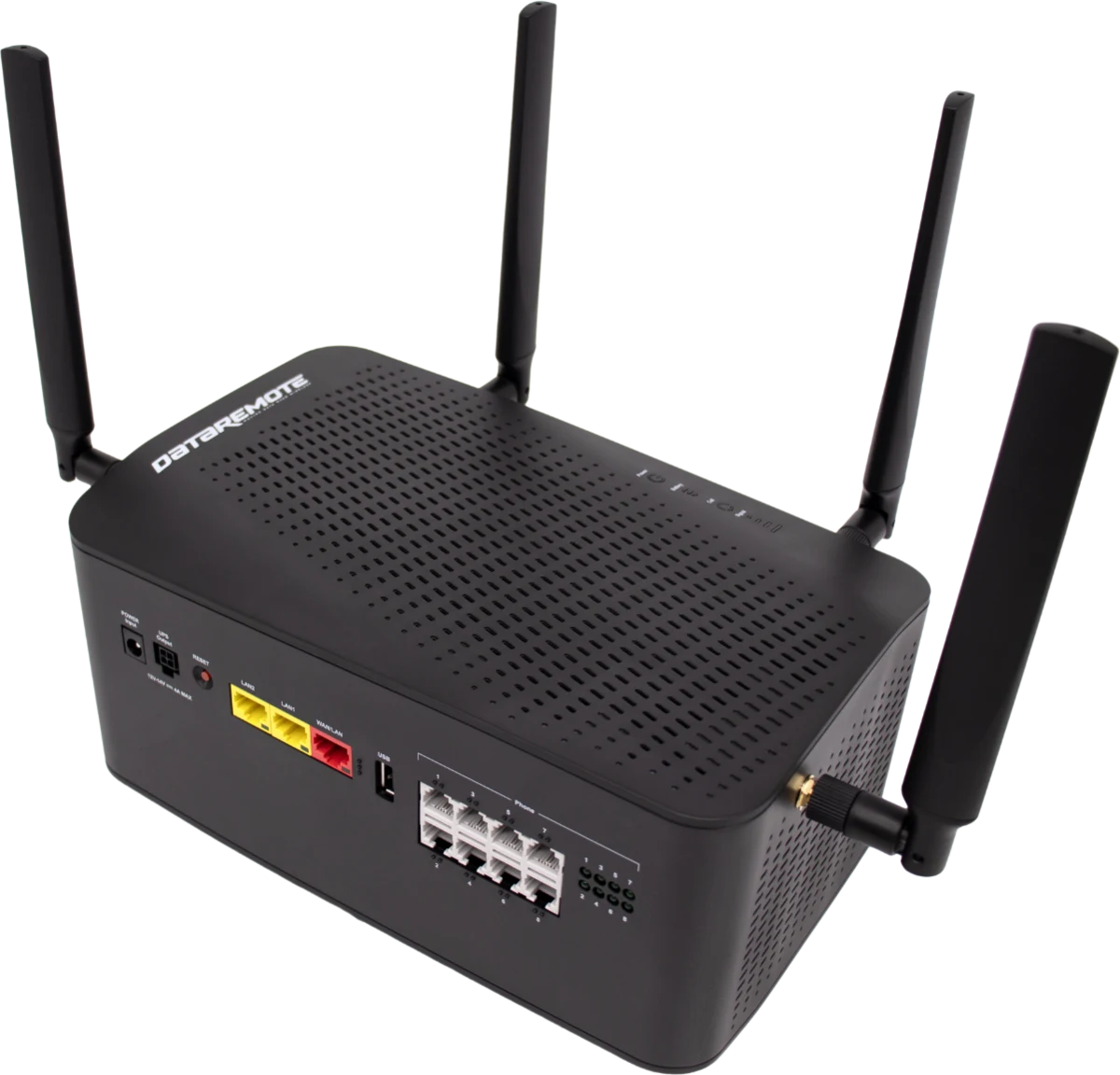 DataRemote · 5G
90X1
Sites with 5G coverage carrying fire, elevator or emergency endpoints.
Full specifications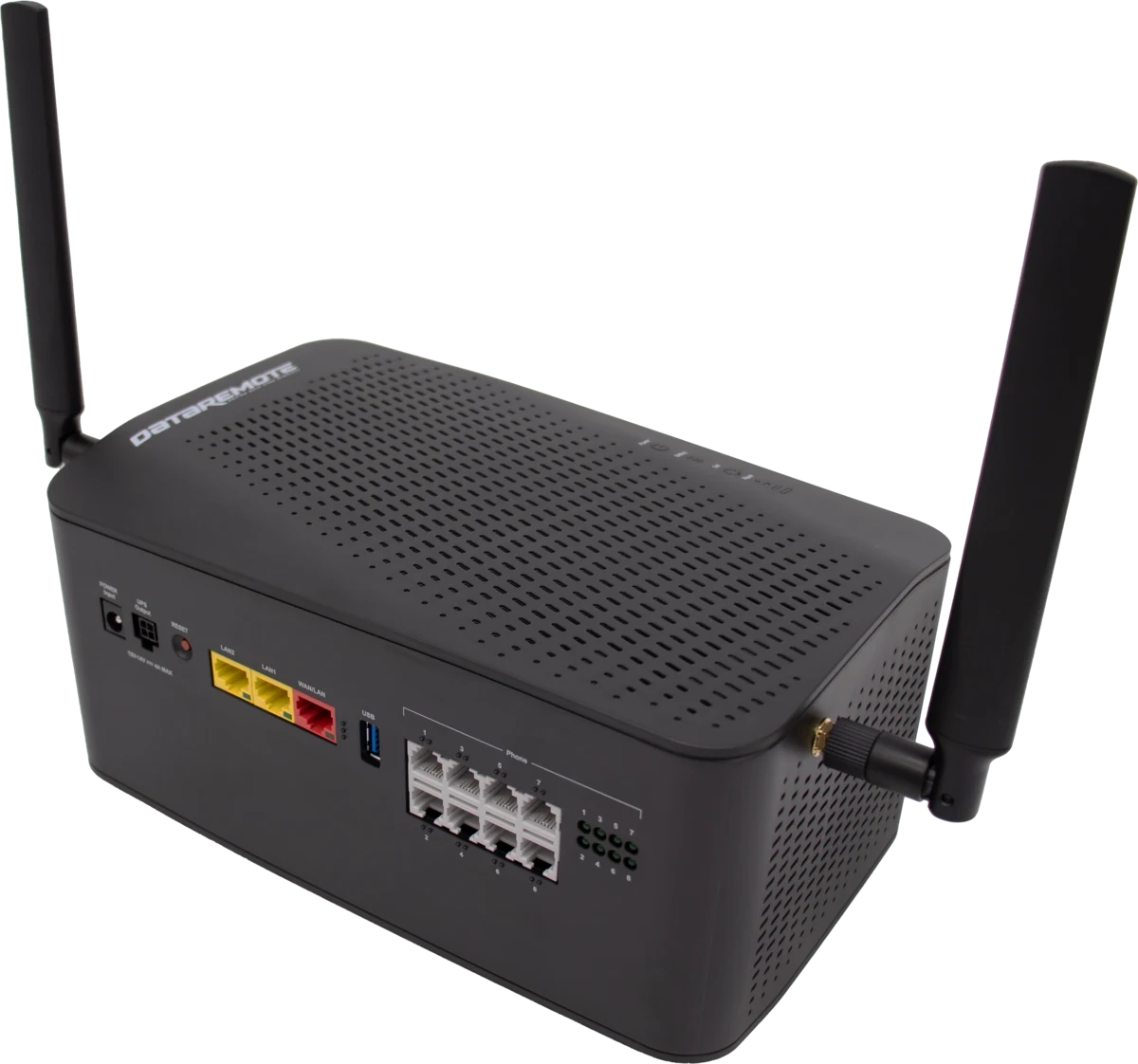 DataRemote · LTE
90X2
Sites without 5G, and anywhere FirstNet priority access matters.
Full specifications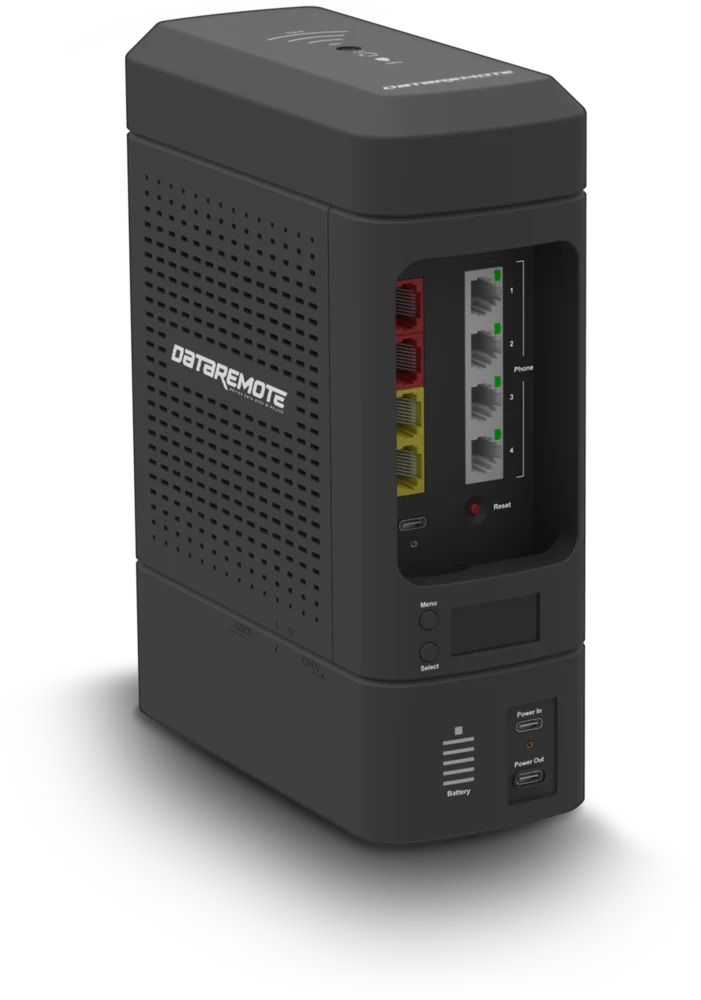 DataRemote · Modular · 5G RedCap
90X5
Signal-difficult buildings — basements, interior cabinets, thick-wall construction.
Full specifications- DataRemote · Device management
Ara
Multi-site fleets where a truck roll costs more than the line does.
Full specifications
Compliance lives in three layers.
Most POTS-replacement pitches blur the device, the network and the installation into a single “fully compliant” claim. An AHJ will not. Here is who is responsible for what.
- 01
The device — DataRemote
The 90X1 and 90X2 are aligned with UL 864 and NFPA 72 requirements for fire alarm signal transmission, carry CSFM listing 7305-2384:0002, and hold UL 2054 (MH63085) battery listings. NFPA 72 is a code applying to the installed system, not a product certification — the AHJ decides whether a given installation meets it.
- 02
The network — MIX Networks
E911 address association and dispatchable-location assignment, 911-call notification to designated on-site contacts, Kari’s Law and RAY BAUM’S Act support, Hosted PBX routing, SOC 2 data centres, and toll-fraud and SIP-anomaly protection are met on the carrying voice network, not by the endpoint hardware.
- 03
The deployment — TrustedNetworx
Site survey, model selection, AHJ coordination, installation, cutover and lifecycle monitoring. Fire alarm and elevator vendors are engaged before cutover, not after an inspection fails.
- 04
Fire alarm transmission — FDNY
FDNY conditionally accepted MIX Networks as a Managed Facilities Voice Network for fire alarm signal transmission using approved equipment. That acceptance is specific to fire alarm signal transmission and to approved equipment — we scope it that way in every proposal.
What the rules actually require
Kari's Law requires multi-line telephone systems to make 911 easier to reach and easier to respond to internally — users must be able to dial 911 directly with no prefix, access code or leading digit required. RAY BAUM'S Act requires 911 calls to include accurate dispatchable location information so emergency responders know where to go.
Everything still hanging on a dial tone.
Each of these terminates on an FXS port and rides the managed cellular path instead.
- Elevator emergency phones
- Fire alarm panels
- Burglar and intrusion alarms
- Fax machines
- POS terminals and ATMs
- Emergency call boxes
- Gate entry and callbox systems
- M2M and SCADA links
- Telemetry and remote sensors
- Utility meter reading
Five steps, and nobody loses a line.
- 01
Line audit
Every analog line inventoried by site, endpoint type, carrier and monthly cost.
- 02
Design
Model selection per site based on coverage, line count and life-safety scope.
- 03
AHJ coordination
Fire alarm vendor, elevator contractor and local authority engaged before any cutover date is set.
- 04
Install and cutover
Installs are typically completed within a few hours per site, with the analog path kept live until the replacement is verified.
- 05
Monitor
Every unit enrolled in Ara and watched by our NOC — line-state alerts, remote diagnostics, firmware lifecycle.
Where we do this work.
- 01
Senior living & healthcare
Emergency phones, nurse call trunks, fire panels, fax lines.
- 02
Property management
Elevator phones, gate entry, callboxes across scattered-site portfolios.
- 03
Hospitality
Fire alarm panels, elevator lines, POS and back-office fax.
- 04
Retail & multi-site
POS terminals, ATMs, burglar and fire alarm transmission at scale.
Get your free line audit.
Tell us about your sites and we'll come back with a plan and pricing within one business day.
Form not loading? Open it in a new tab.