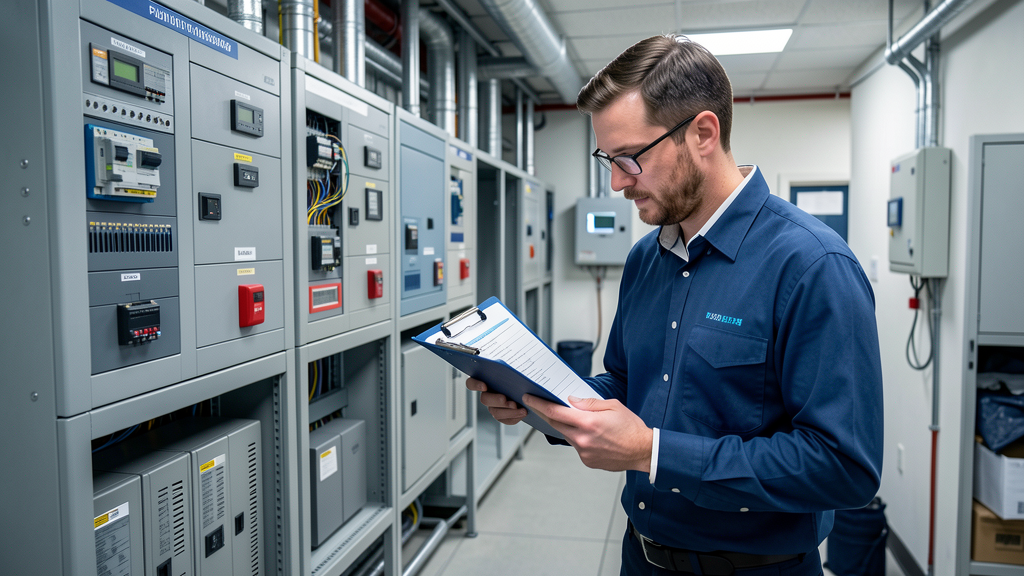
Facility managers carry a load most people never see. HVAC, access control, life safety systems, elevator contracts, parking lot lighting — the list never shrinks. But there's one category that quietly slips through the cracks until an inspector shows up: telecom compliance.
A failed fire alarm communicator during a routine inspection. An elevator phone that can't place a call. A security panel that's been silently running on a POTS line scheduled for disconnection. None of these are hypothetical. We've seen every one of them in the last twelve months.
Here's a practical audit checklist that covers the telecom compliance items most likely to trip you up.
1. Fire Alarm Communicators
Start here. It's the highest-stakes item on your list.
What to check:
- Is your communicator still riding on copper POTS lines?
- When was the last successful signal test to the central station?
- Does the panel log show any "comm fail" events in the last 90 days?
- Is the backup communicator path (cellular or IP) actually functional, or just installed and forgotten?
Why it matters: NFPA 72 requires functional communication paths. If the primary fails and the backup hasn't been tested in a year, you're noncompliant — even if you technically "have" a backup.
Common trap: Facilities that added a cellular dialer five years ago but never switched it to primary. The POTS line degrades. The cell unit sits untested. When the inspector pulls a report, both paths show failures.
2. Elevator Phones
Most people don't think about elevator phones until someone gets stuck.
What to check:
- Does the phone actually connect when you press the call button?
- Does it route to a live person, or does it ring into an empty security desk after hours?
- Is the phone line copper POTS — and if so, is it on the carrier's sunset list?
Why it matters: ASME A17.1 and local building codes mandate operable two-way communication. The common failure isn't the phone — it's the underlying connection.
Common trap: Older buildings with POTS-based elevator phones that route to a front desk that's only staffed 9-to-5. At 8 PM on a Tuesday, that trapped occupant is talking to voicemail.
3. Emergency Communication Systems
Senior living, healthcare, and educational facilities have layered requirements here.
What to check:
- Do emergency call stations (pool phones, parking lot call boxes, blue light phones) actually work end-to-end?
- Are they on monitored lines, or just connected to a PBX extension that nobody tests?
- For senior living: do resident emergency call systems meet the specific requirements in NFPA 72 Chapter 24?
Why it matters: The liability exposure on a failed emergency call is enormous. "I thought someone else was testing it" doesn't hold up after an incident.
4. POTS Line Inventory
This is where the biggest surprise usually lives.
What to check:
- Request a full POTS line inventory from your carrier — not from your own records.
- Cross-reference every line: which ones are active, which are billing-strandeds, which are critical path.
- Check the FCC POTS forbearance timeline for any lines still scheduled for sunset.
Why it matters: Carriers are discontinuing copper at an accelerating pace. When AT&T or Verizon files to retire copper in your exchange, you get a notice with a deadline — not a friendly negotiation window.
Common trap: Facilities that assume their carrier "would have told them" about pending disconnections. They do tell you — via a letter that lands on a desk three organizational layers away from yours.
5. Cell/Radio Signal Coverage
Life safety systems increasingly rely on cellular backup. But "cellular" only works if there's signal.
What to check:
- Walk-test cellular signal strength at every communicator location — especially basement panels, elevator machine rooms, and interior closets.
- Are there any areas with zero bars? Those panels will fail during an outage.
- For facilities with BDA/DAS systems for first responder radio: is the annual recertification current?
Why it matters: A cellular dialer in a basement mechanical room with no signal is decorative, not functional.
6. E-911 Location Accuracy
If your phone system can't tell 911 dispatch exactly where the caller is, you're rolling dice.
What to check:
- When a desk phone dials 911, what address and location detail does the PSAP receive?
- Are floor and room-level details configured, or does every call from a 400,000 sq ft building report the same street address?
- When was the last 911 test call (coordinated with your local PSAP)?
Why it matters: Kari's Law and RAY BAUM'S Act make precise dispatchable location a federal requirement for multi-line telephone systems.
What to do with the results
Run the audit. Build a spreadsheet. Then triage into three buckets:
- Immediate fixes — anything that would fail an inspection today.
- 90-day timeline — items that work today but are at risk (aging copper, pending carrier sunset).
- Documentation gaps — things that probably work but have no test record to prove it.
The facilities that get through inspections smoothly aren't the ones with the newest equipment. They're the ones that can show an auditor exactly what they have, what it connects to, and when it was last tested.
If you want a second set of eyes on your telecom compliance picture, we do this every day. Let's talk.
About the author
Carter Dewey
Carter Dewey is CEO & Founder of TrustedNetworx, helping multi-site organizations navigate telecom modernization, POTS replacement, and AI-powered operations — translating complex infrastructure challenges into practical, phased migration roadmaps.