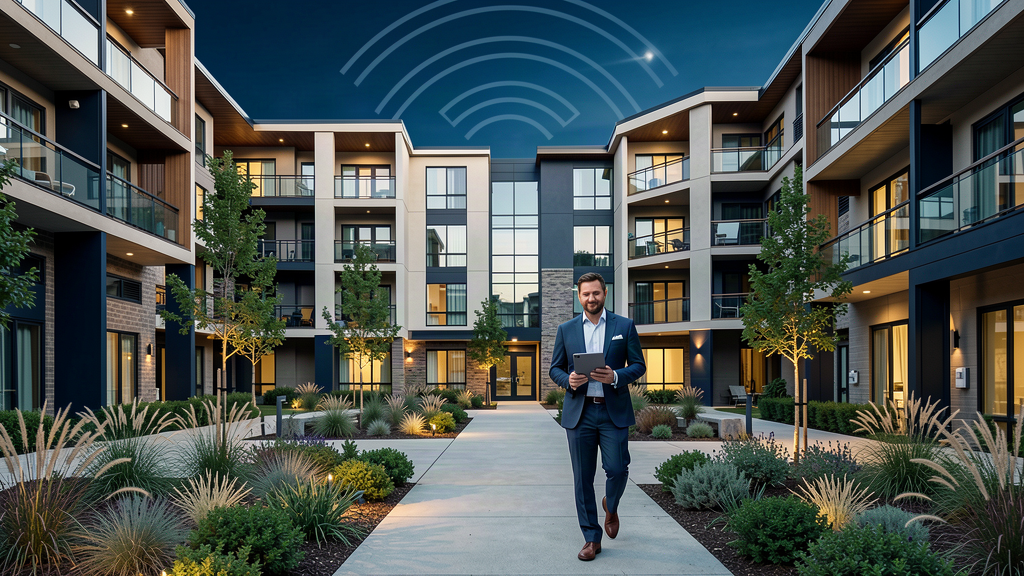
When a property owner asks me about "connectivity amenities," they're usually thinking marketing. A line item on the listing. A box to check so the property shows up in search filters.
That's the wrong frame. Connectivity is a retention and NOI play, not a marketing play. The owners who treat it that way are quietly adding basis points to their cap rate while everyone else re-leases the same units every 18 months.
The Turnover Cost Nobody Puts in the Pro Forma
Here's the math most owners skip. When a tenant moves out, it costs you:
- Lost rent. Thirty to forty-five days of vacancy is normal in a soft market. On a $2,100 unit, that's $2,100 to $3,150 gone.
- Turn cost. Paint, carpet, cleaning, repairs. Another $1,500 to $3,000.
- Leasing cost. A leasing fee or a month of in-house marketing payroll. $500 to $1,500.
So a single avoidable move-out is a $4,000 to $7,000 hit, conservatively. Now ask yourself: what's the number one avoidable move-out reason you can actually control?
It's friction. And bad connectivity is pure friction. Slow internet, dead zones in the bedroom, a provider that takes three weeks to install — none of it shows up on a tour, and all of it shows up on the exit survey.
Connectivity Is a Renewal Decision
Tenants don't renew because the Wi-Fi is great. They renew because nothing about living there is annoying enough to make them move. Moving is expensive and exhausting. Tenants stay where life is easy.
Connectivity is the single biggest lever on "life is easy." When a work-from-home tenant's video call drops during a client meeting, they don't call maintenance — they start browsing listings. You never see that churn coming because it happens silently, months before the lease is up.
The properties that keep their backbone current — fiber ingress, common-area coverage, real in-unit bandwidth — run measurably lower turnover than the ones coasting on whatever the cable company left behind. That's not a marketing claim. It's a retention number you can pull from your own portfolio.
Bulk Agreements Are NOI, Not Amenity
This is where the owner lens changes everything. A bulk internet agreement isn't a perk — it's ancillary income that flows straight to NOI.
At $40 to $60 per unit per month, a 250-unit property adds $120,000 to $180,000 a year to the top line. Because that income is recurring and tied to occupancy, the market capitalizes it like rent. At a 6% cap rate, $150,000 of ancillary NOI is worth $2.5 million of asset value. Full stop.
The same logic applies to the cost side. Consolidating telecom across a portfolio — one provider, one invoice, one escalation path — cuts the per-unit operating expense that every investor's underwriting model is already penalizing you for.
What Investors and Lenders Look At
If you're refinancing or selling, the due diligence now includes questions that didn't exist five years ago. Lenders want to know the building has fiber, not bonded DSL. Buyers want to see the bulk agreement terms. The telecom stack has become part of the asset's capital story.
Owners who treat connectivity as a capital improvement — planned, depreciated, and disclosed — get credit for it. Owners who treat it as an expense to defer until a tenant complains are the ones whose building shows up with a connectivity discount on the buy side.
The Portfolio Play
For owners with multiple properties, the real opportunity is standardization. One provider across the portfolio. The same network design in every building. The same failover posture. The same management console.
It's the difference between running twelve buildings and running one network that happens to span twelve buildings. Every lease, every renewal, every exit survey gets easier to manage — and the data you get back tells you exactly where the next capital dollar should go.
The Bottom Line
Stop thinking about connectivity as an amenity you list. Start thinking about it as an operating asset you own — one that reduces turnover, feeds NOI, and shows up in your building's valuation.
The owners who get this are already doing it. They're the ones whose renewal rate is a few points higher than yours, and whose asset is worth a few million more for the same square footage.
If you want to see what your connectivity stack is costing you in turnover and NOI — and what it would take to turn it into an asset instead of a cost center — let's run the numbers. Let's talk.
About the author
Carter Dewey
Carter Dewey is CEO & Founder of TrustedNetworx, helping multi-site organizations navigate telecom modernization, POTS replacement, and AI-powered operations — translating complex infrastructure challenges into practical, phased migration roadmaps.