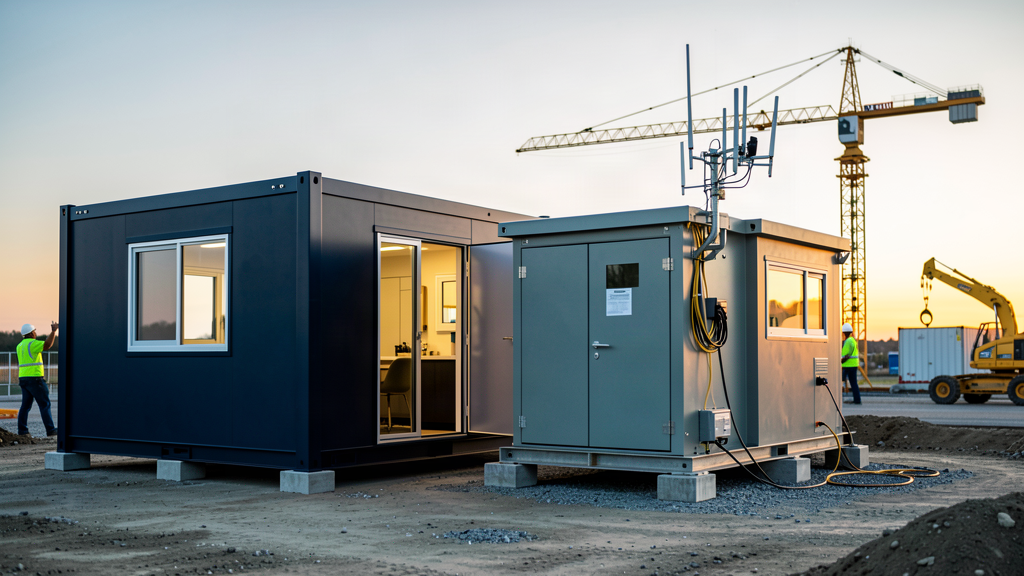
Internet on a construction site is usually someone's side job. The trailer shows up, whoever is closest plugs in a consumer router, and everyone hopes for the best. Then the project goes live — and the plan room can't load drawings, the time clock stops syncing, and the superintendent is standing in the parking lot trying to get a cell signal.
The site was never the priority. The internet just got wired up in whatever order things arrived. That's the whole problem.
Day one is when it breaks
The trailer router is the classic failure point. It's a $90 piece of equipment handling mission-critical traffic for a multi-million-dollar project. It has no failover, no management, and no one who owns it.
Here's what it's actually carrying on most jobsites today:
- Plan and drawing access (Procore, Bluebeam, Autodesk)
- Daily logs, RFIs, and submittals
- Time clocks and payroll
- Security cameras and access control
- VoIP phones in the trailer
- Site-wide Wi-Fi for the field team
- Sensors, drones, and IoT devices
That's not "nice to have" internet. That's the nervous system of the project. When it drops, work doesn't politely pause — it stumbles.
The three things that kill a jobsite connection
The trailer moves. Every phase change, the office trailer gets relocated, and the connection gets yanked and re-terminated. Every move is a new chance for something to be wired wrong.
The weather. Jobsites are exposed. Rain, wind, and heat all take their toll on outdoor cabling and temporary mounts. A connection that worked fine in May can fail in August.
The location. New developments and remote sites frequently have no fiber. The only option is wireless — and that means signal planning, not just "plug it in and hope."
None of these are IT problems in the traditional sense. They're construction problems. The fix has to be built for the way a site actually operates, not for a carpeted office.
Treat connectivity like the utility it is
The most reliable sites we see treat internet the same way they treat power and water: it's spec'd before the trailer even arrives, and it has a backup.
That means two things up front.
A real primary connection. If fiber is available and the schedule justifies it, great. If not, fixed wireless or LTE/5G is the primary — and it needs to be sized for the actual load, not the optimistic estimate from the bid.
A failover that actually fails over. A second carrier on a different network, configured to cut over automatically when the primary drops. The superintendent should never know it happened. The cameras keep recording, the time clock keeps syncing, and the plan room stays up.
This is table stakes for any project where a day of downtime means delayed inspections, missed deadlines, or a safety incident that didn't get caught on camera.
Phased from groundbreaking to punch list
A good jobsite connectivity plan isn't static. It changes as the project does.
Early on, it's a trailer and a handful of users. Mid-project, it's full field coverage and a dozen connected systems. Near handoff, it starts transitioning to whatever permanent infrastructure the owner will inherit.
The provider that handles phase one should be able to handle phase three. If you're swapping vendors every time the site changes shape, you're paying the "rip and replace" tax on every phase.
What to look for in a construction connectivity partner
A few things separate a provider who gets construction from one who doesn't:
- Fast deploys. The schedule doesn't wait. If setup takes weeks, the project is already behind.
- Failover built in. Not offered as an upsell — standard.
- Flexible terms. A jobsite is temporary. You shouldn't be locked into a three-year contract for a nine-month project.
- Someone who answers. When the connection drops at 6 a.m. and concrete is scheduled for 7, you need a human, not a ticket queue.
Connectivity isn't the most glamorous line item on a construction project. But when it's missing, it's the only thing anyone notices. The projects that run smooth aren't the ones with the most expensive tools — they're the ones where the basics just work, every day, from groundbreaking to handoff.
If your jobsite is still running on a trailer router and a prayer, let's talk about what a proper connection looks like.
About the author
Carter Dewey
Carter Dewey is CEO & Founder of TrustedNetworx, helping multi-site organizations navigate telecom modernization, POTS replacement, and AI-powered operations — translating complex infrastructure challenges into practical, phased migration roadmaps.