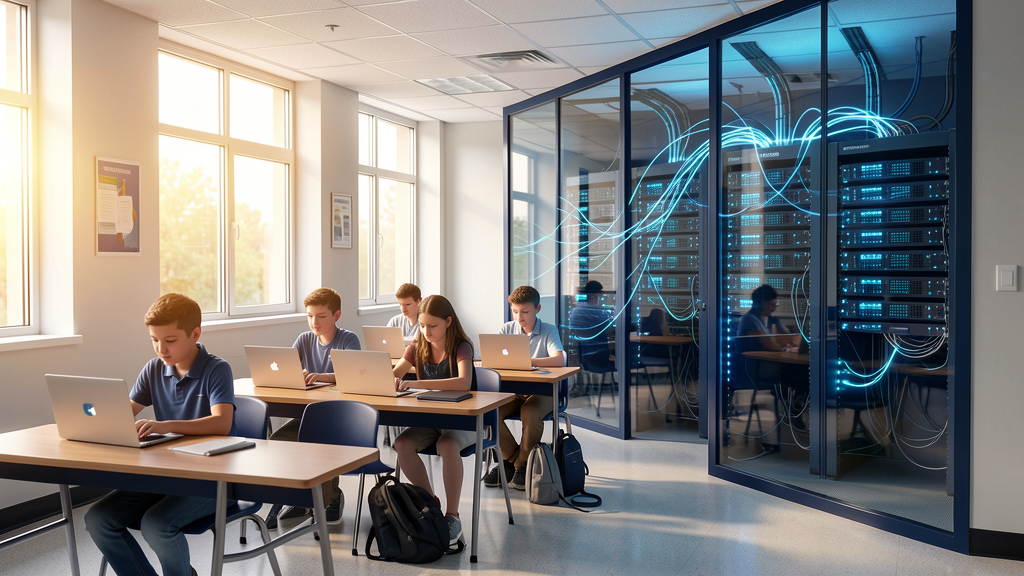
When 2,000 students open their Chromebooks at 8:15 AM, your network has about 90 seconds to prove it's ready. Most aren't.
The problem isn't the internet connection coming into the building. It's everything that happens after that.
The morning rush is a stress test
Schools run on schedules. Every period change means hundreds of devices hitting the network simultaneously. Add in streaming video for instruction, cloud-based testing platforms, administrative VoIP phones, security camera feeds, and guest Wi-Fi for parents — and you're asking a lot from infrastructure that was often installed a decade ago.
A single dropped connection during a state assessment isn't just frustrating. It can invalidate test results for an entire grade level.
What breaks (and when)
The most common failure points are predictable:
Access point density. Many schools deployed one AP per classroom years ago and never revisited it. Today's device count per room is easily double what it was. When 30 students all try to load a video lesson at once, that single AP folds.
Backhaul bottlenecks. Every AP in a wing eventually feeds into a single switch. If that switch uplink is still running at 1 Gbps, the entire wing shares that pipe. Upgrade it.
Legacy phone lines. Yes, copper POTS lines still run the intercom and emergency phones in thousands of school buildings. When the carrier sends a disconnection notice — and they will — there's no quick fix without a plan in place.
Security systems on the same VLAN. When door access control, IP cameras, and student Wi-Fi share a broadcast domain, a misconfigured camera can flood the network and take down testing.
What a school-ready network actually looks like
The districts that get this right share a few patterns.
First, they segment traffic. Student data, administrative systems, security cameras, and VoIP all live on separate VLANs with appropriate QoS rules. A camera firmware update never competes with a math assessment.
Second, they build in redundancy. A single broadband circuit from the local cable company isn't enough when the state mandates online testing. Smart districts pair fiber with a fixed wireless or LTE failover connection. If the primary drops, traffic routes automatically.
Third, they plan POTS replacement before the disconnection letter arrives. Analog phone lines in schools handle more than desk phones — they power elevator emergency phones, fire alarm panels, and security gate call boxes. Replacing those with cellular or VoIP-based alternatives takes lead time. The districts that wait until the carrier cuts them off pay rush fees and deal with downtime.
The numbers matter
A mid-sized school district with 10 buildings and 15,000 students typically spends $8,000–$15,000 per month on telecom services. An audit almost always finds overlap — circuits still billed for buildings that closed, phone lines no one uses, bandwidth packages grandfathered at higher rates than current offerings.
One district we worked with cut 40% of their monthly telecom spend just by consolidating vendors and eliminating unused lines. That savings funded a district-wide wireless upgrade.
Don't wait for the failure
School IT teams operate on the academic calendar. Summer is the window for infrastructure work. If you're reading this and haven't scoped your connectivity upgrades yet, the clock is ticking.
Start with a network audit that covers wired and wireless infrastructure, carrier contracts, and POTS line inventory. Identify the single points of failure. Fix those first.
A school network that survives the day isn't a luxury. It's the baseline for modern education.
Need an education connectivity assessment? Our team audits school networks end-to-end — from carrier contracts to classroom APs. Schedule a consultation and get a plan before the next bell rings.
About the author
Carter Dewey
Carter Dewey is CEO & Founder of TrustedNetworx, helping multi-site organizations navigate telecom modernization, POTS replacement, and AI-powered operations — translating complex infrastructure challenges into practical, phased migration roadmaps.