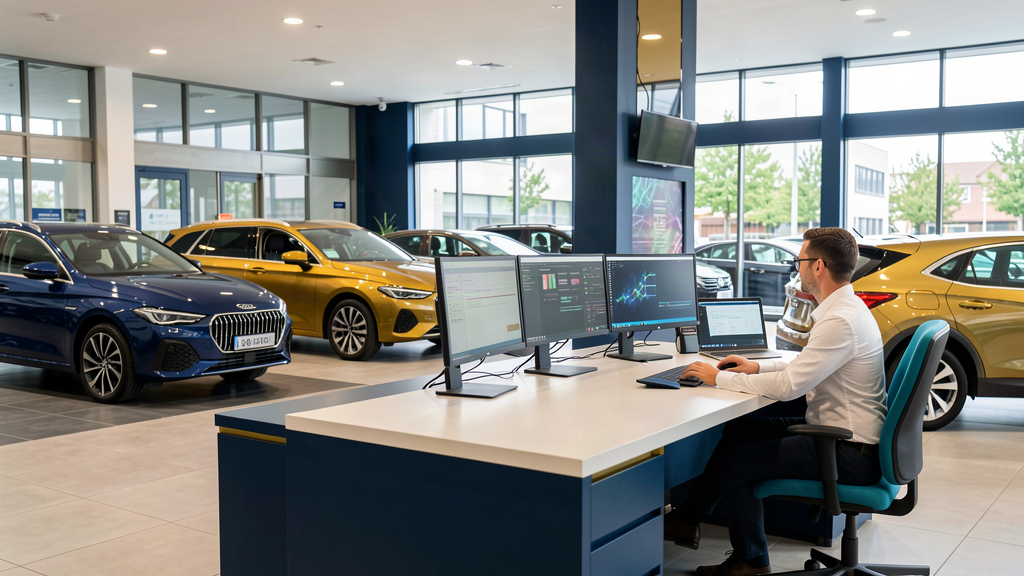
Walk into a dealership the morning the network drops and you'll see something you don't see anywhere else in retail: the entire business stops at once.
Sales can't pull a credit app. F&I can't get a lender's decision. Service can't write a repair order or look up a part. The BDC phones go silent. The parts counter can't scan a single SKU. It isn't a slowdown — it's a shutdown. And every minute it lasts is money walking out the door.
Why a dealership is different
Most businesses can limp through a connectivity outage. A dealership can't, because everything the store does now runs through a cloud-based DMS — the Dealer Management System. CDK, Reynolds, DealerTrack, Tekion. Every one of them is software-as-a-service. No connection, no system. No system, no deals.
That's the part people outside the auto business miss. The network isn't an accessory to the dealership. It is the dealership's operating system. When it goes down, the store doesn't revert to paper and a landline the way it might have in 2005. It just sits there.
What a down day actually costs
Run the numbers on a mid-size store moving 150 cars a month.
Sales. A store that size closes four or five deals a day. Front-end gross runs $2,000 to $3,000 a car, before F&I. If an afternoon outage stalls even two deals — one walks, one gets unwound because the credit app never cleared — that's a five-figure day gone. Not a hypothetical. Every GM has lived some version of it.
Service. This is where the math is easiest. A productive bay bills $150 to $250 an hour. A store with twelve bays has thousands of dollars an hour in play. When the network drops and techs can't pull the repair order, look up the OEM procedure, or close out the job, the bays go idle. Two hours of stall time across the shop is real money — and it's unrecoverable. You can't resell a morning of labor the way you can resell a car.
Parts. Every scan, every cycle count, every emergency order runs through the same pipe. A missed scan during an outage becomes an inventory variance someone has to reconcile by hand later.
The soft costs. A customer in the lounge with no Wi-Fi. A tech standing at a lift with the OEM on hold. A salesperson who can't answer "what's my payment?" These don't hit the P&L as a line item, but they all chip at the CSI score the manufacturer is watching.
Why it keeps happening
Most dealership networks are held together by the same consumer router and cable modem that were in the building a decade ago, plus whatever the last vendor bolted on. That produces the same three failures, every time.
A single circuit. One broadband line, no backup. When the carrier has an outage, or a backhoe finds the fiber, the store goes dark. No failover means the dealership is betting its entire revenue stream on one connection.
No segmentation. Guest Wi-Fi in the lounge on the same network as the DMS and the credit apps. It's a security problem, sure — but it's also a performance problem, because one streaming customer can choke a lane the finance manager needs right now.
Consumer-grade gear. A router built for a house, not a store running 80 devices, metal service bays, and a lot that spans an acre.
What fixes it
The fix isn't a faster pipe. It's a network designed for the way a dealership actually works.
Dual path with automatic failover. A primary connection plus a separate LTE or 5G backup that cuts over on its own. When the fiber drops, the store keeps writing deals. The customer never notices — which is the entire point.
Segmented wireless. Separate networks for the DMS, for payments, for guest Wi-Fi, and for the IoT gear in the service bays. Each isolated, each protected.
SD-WAN at the edge. Traffic shaping so a F&I credit pull beats a customer streaming video, every time, automatically.
Centralized management. For dealer groups with multiple rooftops, one pane of glass across every store. One escalation path, one bill, one standard.
None of this is exotic anymore. It's the same architecture the best-run dealer groups have been rolling out across their rooftops — because they've done the math on what a down day costs and decided it isn't a risk worth carrying.
If you want to know what your store's network would cost you if it died at 2 p.m. on a Saturday, let's map it out. We'll show you what you have, what it costs, and what a network that can't take your whole store down looks like.
About the author
Carter Dewey
Carter Dewey is CEO & Founder of TrustedNetworx, helping multi-site organizations navigate telecom modernization, POTS replacement, and AI-powered operations — translating complex infrastructure challenges into practical, phased migration roadmaps.