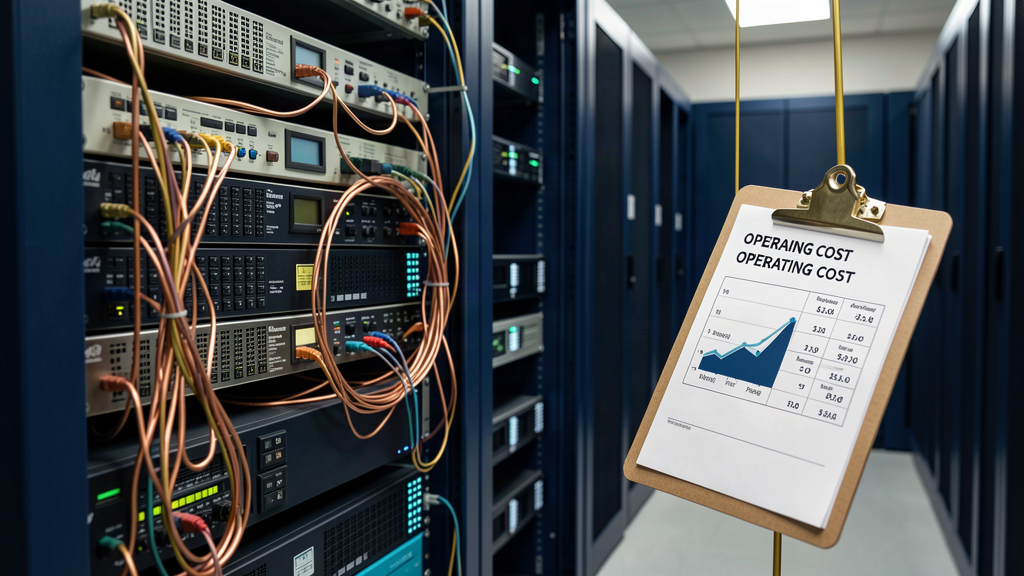
Ask a CFO what the phone system costs and they'll pull up the carrier invoice. That number is real — but it's maybe half the story. The true cost of a legacy phone system in 2026 is a per-line number most organizations have never actually calculated, because the expensive parts don't show up on any single bill.
Here's how to do the math the right way, and why the answer usually points the same direction.
Start with what you know
The visible cost is the easy part. A POTS line still runs $45–$85 a month in most markets. A legacy PBX on top of it usually carries a maintenance contract, an on-call vendor, and a hardware replacement budget for equipment nobody manufactures anymore.
Those are the numbers in the budget. They're also the smallest ones.
The per-line math nobody writes down
Let's use a real example — a business running 40 lines across a legacy PBX and analog circuits:
- Carrier charges: 40 lines at $65 average — $2,600/month
- PBX maintenance contract — $400/month
- One truck roll per month (parts plus labor) — $300
- Internal IT time chasing phone problems: six hours a week at $40/hr — roughly $1,040/month
That's about $4,340 a month before a single "soft" cost enters the picture. It works out to nearly $109 per line per month.
Now add what that invoice never shows.
The costs the invoice hides
Downtime. When a legacy circuit fails, the fix is a truck roll measured in hours or days, not minutes. If the downed line feeds an elevator phone or a fire alarm communicator, you're carrying a compliance exposure while you wait — and that exposure has a price whether or not anyone writes it down.
Parts. Legacy PBX components come from the secondary market now. A line card that cost $500 new can run $2,500 when there are only a handful left in circulation. At some point "one more repair" quietly becomes more expensive than replacing the whole system.
Talent. The technicians who actually know Nortel, Avaya Partner, and Merlin Magix are retiring. A shrinking bench means higher rates and longer lead times for the people who can still touch your system. You're not a customer anymore — you're captive revenue.
Opportunity. Your legacy system can't transcribe voicemail, route calls on customer data, or log activity into your CRM. Every hour your team spends doing that by hand is labor you've already paid for — spent on work a modern system does automatically.
What those same 40 lines cost modernized
Run the same 40 lines through a modern replacement and the numbers change fast:
- Hosted VoIP / SIP trunking: 40 seats at $20 average — $800/month
- Cellular POTS replacement for the eight compliance lines (fire alarm, elevator, security): 8 units at $30 — $240/month
- No maintenance contract. No truck rolls. No parts shelf.
Total: about $1,040 a month. That's a $3,300 monthly difference — nearly $40,000 a year — and the modern setup adds call routing, voicemail transcription, and CRM integration the old system never had.
The savings get the headlines, but the operational shift matters more. Your team stops babysitting a phone system and starts doing the work the business actually pays them for.
Do your own math in 30 minutes
Pull three numbers: your carrier invoice, your maintenance and repair spend over the last 12 months, and a rough estimate of internal IT time on phone issues. Add them together and divide by your line count.
If the result is above $60 per line per month, you're overpaying — and there's almost certainly a modern replacement that costs less while doing more. Most organizations we run this exercise with land between $80 and $140 per line. That's not a phone bill. That's a leak.
Running the numbers on your system is the fastest way to find out whether modernization pays for itself — and in our experience it usually does, inside 60 to 90 days. Let's run yours.
About the author
Carter Dewey
Carter Dewey is CEO & Founder of TrustedNetworx, helping multi-site organizations navigate telecom modernization, POTS replacement, and AI-powered operations — translating complex infrastructure challenges into practical, phased migration roadmaps.